Logic for scientific inference
Logical methods for uncertain, incomplete, or conflicting evidence in data-driven science, with a focus on support, rejection, and explanation.
Research
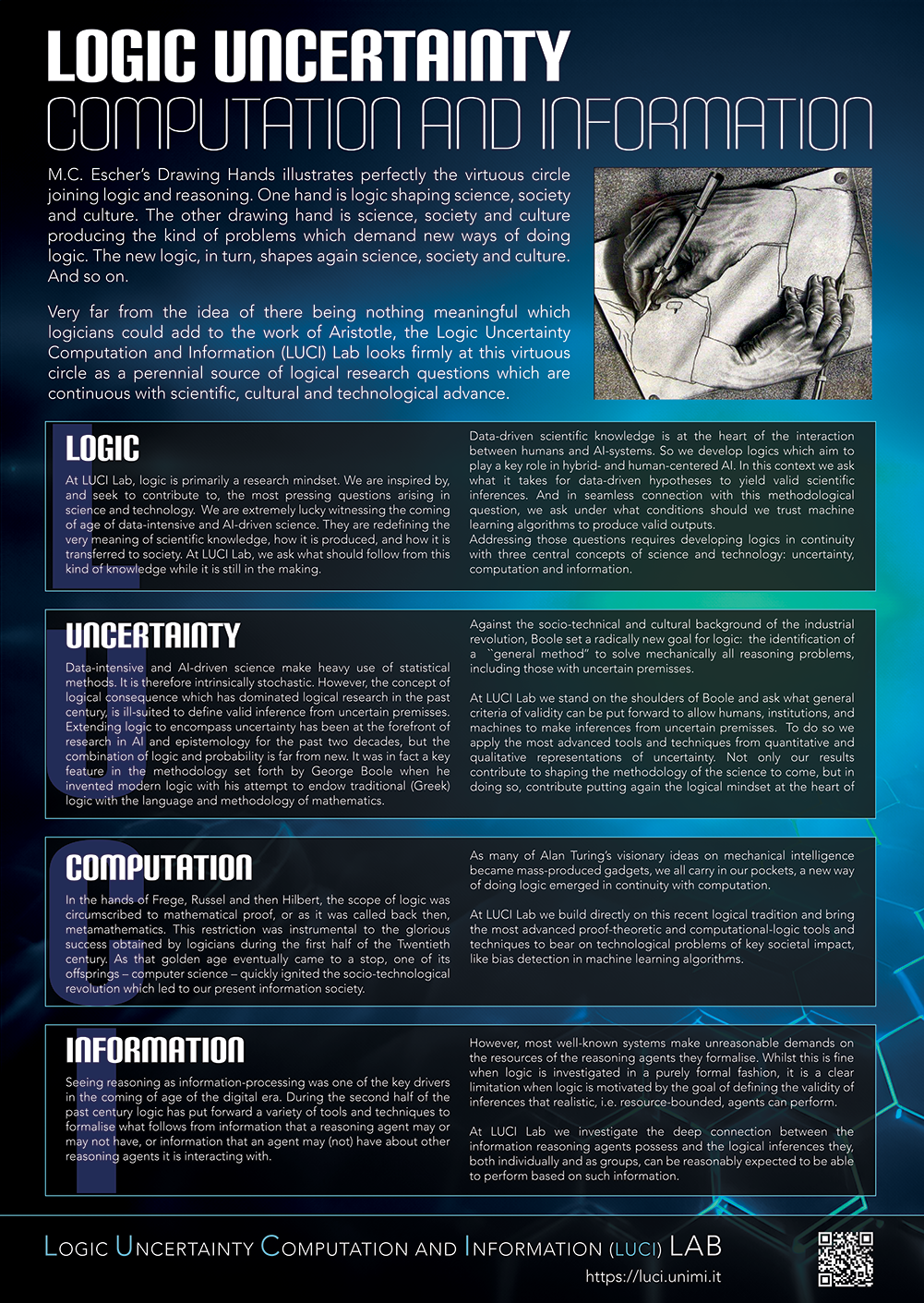
LUCI takes its name from the four concepts that organise the lab’s research agenda: logic, uncertainty, computation, and information. This research topic presents them not as isolated domains but as a single methodological programme driven by present-day science and technology.
At LUCI Lab, logic is not treated only as the study of formal proof. It is a general way of asking what should follow from knowledge while that knowledge is still being constructed. This is especially important in data-intensive and AI-driven science, where methods, evidence, and interpretation evolve together.
Scientific and social inquiry increasingly rely on statistical, probabilistic, and machine-learning methods. These settings require logical tools that can reason from uncertain premises rather than only from fully settled facts. LUCI therefore works on qualitative and quantitative representations of uncertainty, connecting logic with probability, evidence, and explanation.
Modern logic grew in direct continuity with computation. LUCI builds on that tradition by using proof-theoretic and computational-logic tools to address problems with clear societal impact, including the analysis of machine learning systems and formal models of rational agency.
Reasoning is also information processing. A central LUCI concern is the relation between the information available to an agent and the inferences that agent can reasonably be expected to perform. This perspective links the foundations of logic with realistic human and artificial reasoning.
This research area is unified by a single claim: contemporary logic should help us understand how evidence is generated, how information is represented, how computational systems act on it, and how uncertainty affects what can be validly inferred. That shared programme is what ties together the more specific LUCI themes presented below. cross these projects, we ask when data-driven outputs support justified inference, how realistic agents can reason under limits, how digital counterparts can be trusted, and how algorithmic systems can be made more fair and accountable.
Logical methods for uncertain, incomplete, or conflicting evidence in data-driven science, with a focus on support, rejection, and explanation.
Approximating ideal logic so that valid inference can be studied under realistic limits of information, time, and computational effort.
Logical criteria for evaluating when a digital counterpart, simulation, or opaque computational system can be trusted for the task at hand.
Formal and software-oriented methods for detecting, comparing, and mitigating unfair behaviour across machine-learning pipelines.