Research
Logic for scientific inference
Logical methods for uncertain, incomplete, or conflicting evidence in data-driven science, with a focus on support, rejection, and explanation.
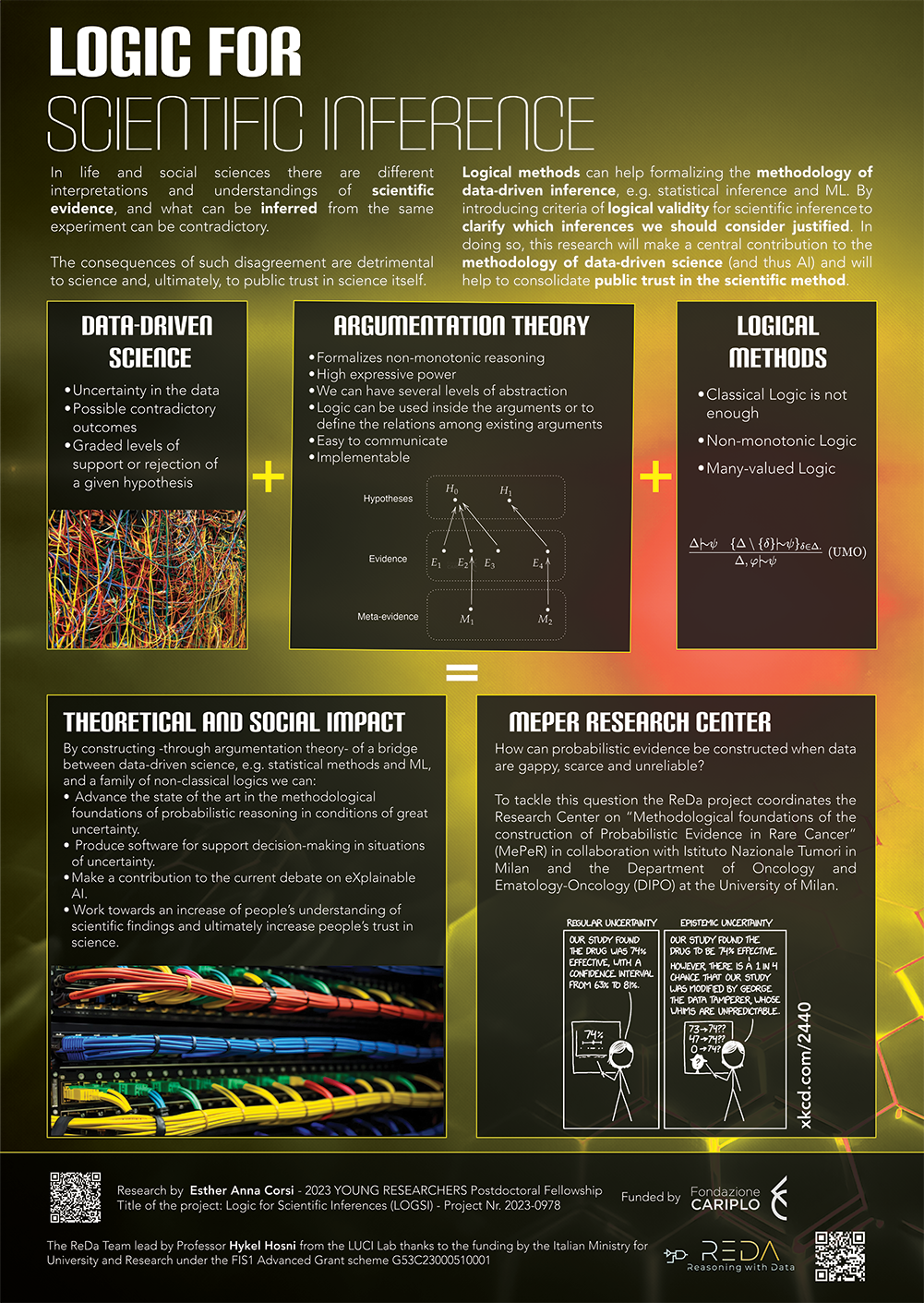
Logic for Scientific Inference (LOGSI) focuses on a basic problem in contemporary science: the same body of data may support different and even conflicting interpretations. LUCI studies how logical methods can clarify what follows from evidence in those settings and under what conditions scientific conclusions are justified.
The problem
In life and social sciences, evidence is often incomplete, noisy, scarce, or contradictory. That makes it difficult to determine when a hypothesis should count as supported, rejected, or left open. Disagreement of this kind is not only a technical matter: it can also affect public trust in science.
The logical approach
This research topic connects data-driven scientific practice with families of non-classical logics that can handle uncertainty and disagreement more explicitly than classical consequence alone. The key ingredients include:
- argumentation theory, to represent competing lines of support and attack
- non-monotonic logic, to model defeasible reasoning that can change when new evidence appears
- many-valued logic, to represent graded levels of support, rejection, or indeterminacy
What this line of research aims to do
This work develops methodological foundations for reasoning under uncertainty in a way that remains both rigorous and explainable. It also supports software-oriented goals, including tools for communicating how scientific conclusions are reached and why rival conclusions may still be rationally comparable.
ReDa / MEPER line
This theme is also linked to the ReDa project on the construction of probabilistic evidence in rare cancer contexts. That line of work brings logical analysis into contact with biomedical applications where data are often gappy, scarce, and methodologically difficult.