Research
Logics for trustworthy digital copies
Logical criteria for evaluating when a digital counterpart, simulation, or opaque computational system can be trusted for the task at hand.
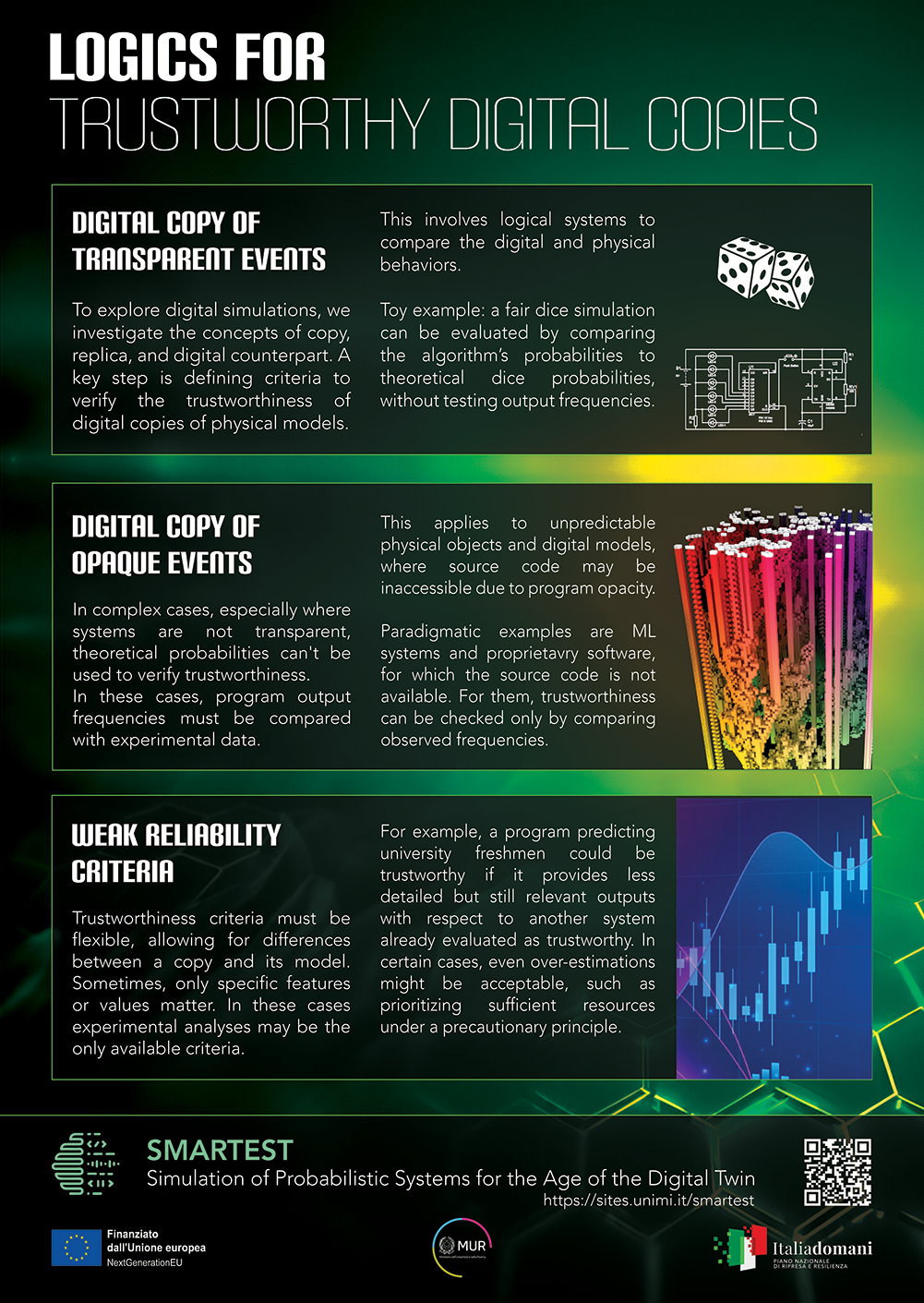
SMARTEST examines how we should evaluate the trustworthiness of a digital copy of a physical system. LUCI uses logic to study the concepts of copy, replica, and digital counterpart, and to identify criteria for when a digital model is reliable enough for a given purpose.
Transparent cases
When the underlying system is sufficiently transparent, a digital copy can be assessed against theoretical expectations and formal behavioural constraints. This research topic illustrates the point with the example of a simulated fair die, where expected probabilities can be compared directly with the model’s specification.
Opaque cases
Many important systems are not transparent. Machine-learning systems and proprietary software may hide their internal mechanisms, or the physical process being modelled may itself be difficult to describe analytically. In those cases, trustworthiness must often be evaluated by comparing observed output frequencies with empirical data rather than by checking the structure of the system alone.
Weak reliability criteria
This line of research also stresses that trustworthiness does not always require perfect feature-by-feature identity. Sometimes a digital counterpart may be acceptable if it preserves the right level of detail for the relevant task, even when some values are simplified, coarsened, or conservatively overestimated.
Why this matters
This work is especially relevant in the age of simulations and digital twins. It provides a logical vocabulary for deciding when a digital system should count as an adequate counterpart for prediction, intervention, or planning.